

 Current position > News detail
『Propeller Type Flow Meter: Mechanical High-Volume Irrigation Water Valves』Related information(flow rotameter|digital flow meter|balo meter|hydraulic flow meter|volumetric meter|positive displacement meter|pitot tube flow meter|displacement meter|cfm meter|variable area flow meter|inline flow meter|differential pressure flow meter|calibrated flow meter|velocity meter|paddle wheel flow meter|oval gear flow meter|anemometer hvac|multiphase flow meter|doppler flow meter|thorpe tube flowmeter|heat flow meter)

Propeller Type Flow Meter for High-Volume Irrigation Water Valves
Quick Answer: A propeller type flow meter gives you totalized volume and instant flow rate for large diameter irrigation valves. It works best with clean water, minimal straight upstream pipe, and pipe sizes from DN50 up to DN600. Many Australian farms and irrigation contractors choose it because it needs no external power and keeps head loss low.
Silver Automation Instruments has been supplying these meters to water authorities, sugarcane growers and turf farms across Queensland, NSW and Western Australia for years. The model we recommend for irrigation mainlines is the SP series propeller flow meter. It has a 360-degree rotatable register, IP68 rating and optional 4-20 mA output. No oil filling, no gear trains. Just a water-lubricated bearing and a slow-spinning propeller that matches flow velocity.
In practice, irrigation engineers often need a meter that survives dirty canal water or bore water with some sand. Here is the thing: a propeller meter can handle a bit of silt if you install a simple strainer or allow a settling distance. The bearing material is tungsten carbide on ceramic, so it will not seize under light sand load. We have seen this on customer sites many times in the Philippines and Mexico where surface water has suspended solids. These meters still give totalization accuracy of ±2% of reading.
Why mechanical over mag or ultrasonic for irrigation? Because a mechanical propeller flow meter does not need a 240V power supply, a signal converter or battery changes every 6 months. The register head runs on a sealed mechanical counter with a sweeping dial. When a water valve opens, flow spins the propeller. A magnetic coupling transfers rotation to the register. You read total megaliters directly, no software, no commissioning. Farmers and pump operators trust them because they work when the power is out.
Pipe sizes and K-factors Typical orders we ship from our Nanjing warehouse: DN80 for lateral lines in vineyards, DN150 for small pump stations, DN300 for main canals and DN500 for river offtakes. Every meter has an individual K-factor in pulses per cubic meter. If you add an electronic pickup, you can send pulse output to a PLC or our paperless recorder for remote monitoring. We often supply meters with pulse reed switches and 4-20 mA analogue output for SCADA integration in water treatment plants.
Installation and straight pipe Most propeller flow meters need 5D upstream and 1D downstream. A partially open butterfly valve directly upstream will create swirl that under-registers flow. But if you mount the meter downstream of a full-bore gate valve or on a long straight section, accuracy returns to specification. We once worked with a maize grower in Zambia who had a 45° elbow just 1 metre before the meter. He saw a 12% under-reading. We guided him to move the meter 6 metres downstream. Problem solved. That meter has been counting seasonal water volumes for three years without a single maintenance call.
Low head loss for gravity-fed systems Propeller meters create very low pressure drop. A DN400 meter at 3 m/s velocity drops about 0.03 bar. That matters when you are running a gravity-fed canal with only 0.5 bar of natural head. Electromagnetic meters add zero head loss but cost significantly more and need an IP67 remote converter. A mechanical propeller meter fits the budget of most district water schemes serving 200 to 500 hectares.
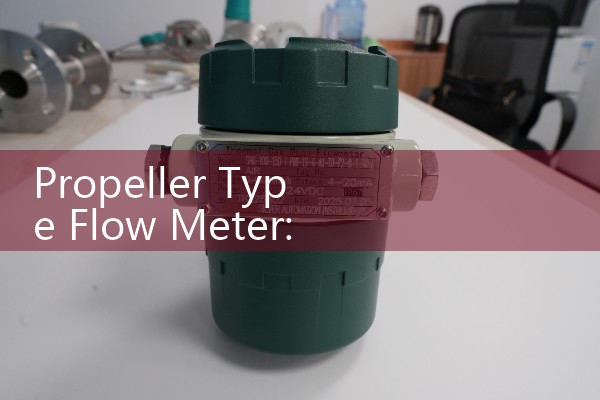
Materials and wetted parts The body is epoxy-coated ductile iron or gunmetal. The propeller itself uses reinforced polypropylene or stainless steel 316L for saline water. If you are measuring treated effluent or brackish bore water, specify 316L propeller and shaft. For seawater irrigation of halophyte crops, we can supply a super duplex propeller shaft assembly. But for standard river water, the PP propeller works for years. We have sold more than 600 SP meters into Southeast Asian shrimp farms where water is brackish. They specify the 316L version and change O-rings every two years.
Price and delivery Price for a DN100 propeller flow meter with mechanical register starts around USD 280 EXW. Larger DN300 units with pulse output and IP68 sealed register go around USD 580 to USD 720 depending on options. We keep stock in Australia through our Sydney partner and dispatch within 48 hours. For markets in Latin America, the Middle East and Africa, we ship by air freight from Nanjing within 5 working days for standard models. Full volume orders go by sea.
Send your specific data for a quote
Do not just ask for a price list. Send us your water quality (fresh, brackish, raw canal), pipe size (DN), flow range in m³/h, operating pressure (bar) and valve type. Our engineers pick the right propeller material and K-factor range for your actual operating point. Email: [email protected] or WhatsApp: 86-135-12131526. Our Australian clients also call direct at +86-135-1213-1526 during AEST business hours. Many customers send photos of their existing meter flange and we match the bolt pattern within hours.
Frequently Asked Questions
1. Can a propeller flow meter work vertically?
Yes. With flow going upwards, accuracy holds. Downward flow needs backpressure to keep the propeller fully wetted. Specify installation orientation when ordering and we calibrate accordingly.
2. What is the minimum flow velocity for reliable measurement?
0.3 m/s is the typical lower limit. Below that, bearing friction dominates. We can supply a low-flow propeller rotor that extends the range down to 0.15 m/s for canal seepage monitoring.
3. How often does it need maintenance?
In clean water, every 3 to 5 years inspect the bearing and seal. In sandy water, clear the strainer monthly. The entire insert except the body can be replaced in 15 minutes with a single wrench.
4. Can I add a remote display?
Yes. The pulse output connects to our wall-mount totalizer or a Paperless Recorder. We have a customer in Peru who transmits total flow from 12 propeller meters to a central control room via RS485 Modbus. We can supply the full solution including shielded cable.
5. Does the meter require batteries?
The mechanical register needs no power. If you add an electronic display or 4-20 mA output, that module runs on a 24 V DC loop supply or an internal lithium battery with 3-year life. We can supply both options.
About Silver Automation Instruments
We manufacture Propeller, Coriolis, Electromagnetic, Ultrasonic, Vortex, Oval Gear and Thermal Mass flow meters. Our calibration rigs handle up to DN3000 with NIST-traceable master meters. We export to 68 countries, with spare parts stock in Southeast Asia and Australia. Whether you need one water valve meter or a complete telemetry package, we handle the full supply chain. Contact us and mention your project location for a specific reference case.