

 Current position >About Us
How is the quality of a mass flow meter calculated? The mass flow meter directly or indirectly measures the mass flow rate of a fluid, and the specific calculation method depends on its working principle. The following are several main types of mass flow meters and their calculation methods for mass flow rate
1. * * Coriolis Mass Flowmeter * *: The Coriolis flow meter directly determines the mass flow rate by measuring the Coriolis force of the fluid inside the vibrating tube. When fluid flows through a U-shaped or spiral vibrating tube, it will cause distortion of the tube, and the degree of distortion is proportional to the mass flow rate flowing through it. By monitoring the vibration frequency and phase difference, the instrument can calculate the mass flow rate without the need for separate measurements of density, temperature, or pressure compensation.
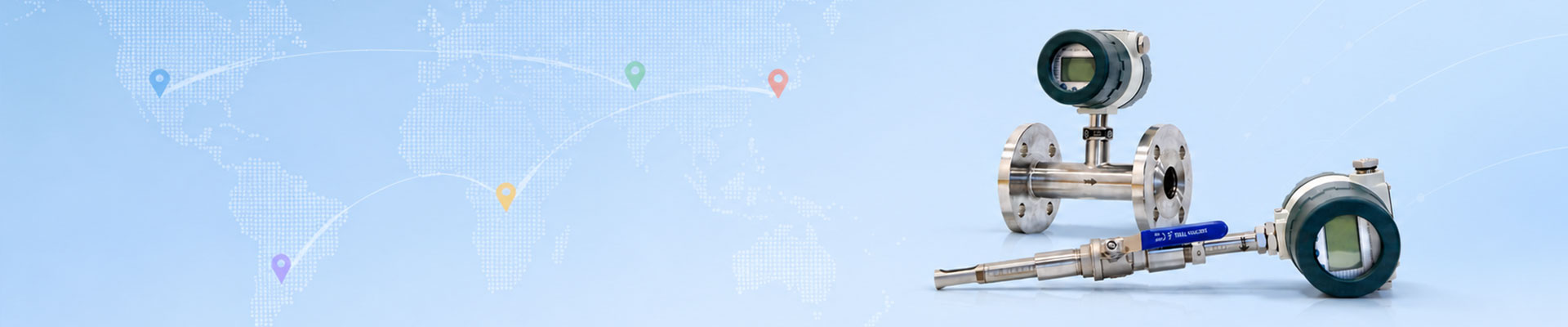
2. * * Thermal Mass Flowmeter * *: A thermal mass flowmeter determines the mass flow rate by heating the fluid with a heating element and measuring the speed at which the fluid carries away heat due to its flow. The faster the flow rate, the more heat is carried away, resulting in a larger temperature difference between the two ends of the sensor. By combining the thermal properties of the fluid, such as thermal conductivity and specific heat capacity, the mass flow rate can be calculated. 3. Differential pressure mass flow meters (such as Delta P Flowmeters) indirectly calculate the mass flow rate by measuring the pressure difference generated before and after the fluid flows through the throttling device. When calculating, it is necessary to consider the density, flow velocity, and geometric dimensions of the throttling device of the fluid. Specific calculations usually follow the Bernoulli equation and related principles of fluid mechanics, and may require temperature and pressure compensation to determine the actual density of the fluid under working conditions.
4. * * Combination of volumetric flowmeter and densitometer * *: When using a volumetric flowmeter (such as a turbine flowmeter or vortex flowmeter) combined with an online densitometer, the volumetric flow rate is measured first, and then multiplied by the real-time measured fluid density to obtain the mass flow rate. All of these methods are based on physical principles, determining mass flow rate by directly or indirectly measuring the physical properties of the fluid, such as velocity, density, and thermal conductivity. The design of a mass flow meter typically includes built-in calculation logic or software that can automatically perform these calculations and provide direct readings of the mass flow rate.